

Community
Spanning an impressive 48,500 hectares, the Khan-Uul School District plays a pivotal role in
addressing the educational demands of the Khan-Uul district in Ulaanbaatar, the capital city of Mongolia. Strategically situated at the nexus of the country’s burgeoning light industry, the district is rapidly evolving as a hub for various sectors, including leather production, wool cashmere, tourism, education, culture, and health. This dynamic environment fosters a unique synergy between industrial growth and educational development.
The Khan-Uul School District is home to a diverse array of educational institutions, comprised of 18 public schools and 25 private schools, bringing the total to 43 active educational establishments. Within these institutions, approximately 31,174 students are enrolled in public schools, while 9,618
students attend private schools. This substantial student population reflects the district’s commitment to providing diverse educational opportunities that cater to the varying needs of its residents.
Moreover, the district supports early childhood education through 28 public and 98 private kindergartens, totaling 126 institutions dedicated to nurturing young minds. This extensive network of schools and kindergartens not only underscores the district’s dedication to educational accessibility but also highlights its role in fostering the intellectual development of future generations.
School
Established in 2016, Mongol Bilig Oyun School stands as a prominent private educational institution in the region, dedicated to nurturing and fostering the potential of its students. With an enrollment of 1,100 students across its kindergarten and K-12 programs, the school has demonstrated a substantial commitment to providing quality education and holistic development. The institution accommodates 910 scholars in the K-12 segment, reflecting its robust approach to academic excellence.
Mongol Bilig Oyun School and Kindergarten Complex is accredited by Integrated Management System ISO 21001:2018 and ISO 9001:2015 and implements Cambridge InternationalCurriculum.
The school counseling services and guidance department at MBO was established at the beginning of the 2021-2022 school year. We have been working hard on developing counseling services that are unique to our student body, while actively integrating with international school counseling strategies and demands.
Curriculum
The academic program is organized on a rotating block schedule. Under this model, students participate in four 40-minute block classes, alongside attending eight block classes and a regular class daily. This structure allows for year-long block classes that convene every other day
Grade 10 and Grade 11 students are afforded the opportunity to select additional subjects at their discretion, thereby allowing them to tailor their learning experience according to their interests and academic aspirations.
However, as students progress to Grade 12, the academic landscape shifts, imposing a mandatory requirement for assessment in four extra subjects
| Department | Grade 9 | Grade 9 | Grade 10 | Grade 10 |
|---|---|---|---|---|
| Compulsory | Elective | Compulsory | Elective | |
| Department of Language | Mongolian language | Mongolian language | ||
| Literature | Literature | |||
| Mongolian script | Mongolian script | |||
| English | English | |||
| Global perspective | Global perspective | |||
| Chinese | Chinese Global perspective |
|||
| Department of Maths & Science | Mathematics | Mathematics | ||
| Physics | Physics | |||
| Chemistry | Chemistry | |||
| Biology | Biology | |||
| Geography | Geography | Physics Chemistry Biology |
||
| Department of Humanities | History | History | History | History |
| Social science | Sociology | Social science | Sociology | |
| ICT | Business studies | ICT | Business studies | |
| Art & Design | ICT | Art & Design | ICT | |
| Physical education | Computer science | Physical education | Computer science | |
| Wellbeing | Wellbeing | Art & Design | ||
| Department | Grade 11 | Grade 11 | Grade 12 | Grade 12 |
|---|---|---|---|---|
| Compulsory | Elective | Compulsory | Elective | |
| Department of Language | ||||
| Literature | Literature | |||
| Mongolian script | Mongolian script | |||
| English | English | |||
| Global perspective | Global perspective | Global perspective | Global perspective | |
| Mongolian language | Mongolian language | |||
| Department of Maths & Science | Mathematics | Geography | Mathematics | Mathematics |
| Physics | Physics | Geography | Geography | |
| Chemistry | Chemistry | Physics | Physics | |
| Biology | Biology | Chemistry | Chemistry | |
| Geography | Biology | Biology | ||
| Department of Humanities | History | History | ICT | History |
| Social science | Social science | Art & Design | Social science | |
| ICT | Sociology | Physical education | Business studies | |
| Art & Design | Business studies | Wellbeing | Art & Design | |
| Physical education | Art & Design | |||
| Wellbeing | ||||
Cambridge International Results
Partnering with Cambridge International allows our students to have access to an internationally renowned curriculum backed by the first-class teaching and research departments of the University of Cambridge. Cambridge International works with over 10,000 schools, across 160 countries. Tens of thousands of students use Cambridge exam grades every year to gain entrance, advanced placement, or credit at leading universities worldwide.
| 2021 | 2022 | 2023 | 2024 | |
|---|---|---|---|---|
| Cambridge Primary Checkpoint | 12 students | 52 students | 36 students | 83 students |
| Cambridge Lower Secondary Checkpoint | 31 students | 32 students | 56 students | 57 students |
| Cambridge IGCSE | – | 15 students | 32 students | 23 students |
| Cambridge AS&A | 1 student | – | – | 24 students |
Grading and Ranking
School policy eliminated class rank beginning with the Class of 2023. GPA is computed using the below quality points. Beginning with grade nine, all subjects, whether passed or failed, are included in the computation.
| Percentage | Grade | GPA |
|---|---|---|
| 97-100% | A+ | 4.0 |
| 93-96% | A | 3.9 |
| 90-92% | A- | 3.7 |
| 87-89% | B+ | 3.3 |
| 83-86% | B | 3.0 |
| 80-82% | B- | 2.7 |
| 77-79% | C+ | 2.3 |
| 73-76% | C | 2.0 |
| 70-72% | C- | 1.7 |
| 67-69% | D+ | 1.3 |
| 63-66% | D | 1.0 |
| 60-62% | D- | 0.7 |
| 0-59% | F | 0.0 |
Academic year calendar:
| Term 1 | 1st September to 27th December |
|---|---|
| First day of class | 1st of September |
| Winter break | 28th December to 26th January |
| Term 2 | 27th January to 4th April |
| First day of class | 27th of January |
| Spring break | 5th April to 13th April |
| Term 3 | 14th April to 13th June |
| First day of class | 14th of April |
| Summer vacation | 14th June to 31st August |
GPA earnings over the last three academic years
| Class of | 2022 (45) | 2023 (44) | 2024 (24) |
|---|---|---|---|
| GPA 4.0 | 10 | 5 | 8 |
| GPA 3.9 | 17 | 14 | 8 |
| GPA 3.7 | 14 | 16 | 8 |
| GPA 3.3 | 4 | 9 | – |
Standardized Test Results over the last three academic years
| Class of | 2022 (45) | 2023 (44) | 2024 (24) | |||
|---|---|---|---|---|---|---|
| Percentage | Average point | Percentage | Average point | Percentage | Average point | |
| IELTS | 33% | 6.71 | 36% | 6.8 | 62% | 6.7 |
| TOPIK | 0.2% | 4.0 | 0.4% | 5.0 | 0.4% | 4.0 |
| SAT | 0.4% | 1148.7 | 27% | 1185.6 | 12% | 1148.7 |
| HSK | 0.2% | 5.0 | ||||
Post High School Placement over the last three academic years
| Class of | 2022 (45) | 2023 (44) | 2024 (24) |
|---|---|---|---|
| International Colleges/ Universities | 42% | 52% | 66.7% |
| Domestic Colleges/ Universities | 52% | 42% | 25% |
| GAP year | 6% | 6% | 8.3% |
University Placements 2021-2024
| 2021-2022 (45) | 2022-2023 (44) | 2023-2024 (24) |
|---|---|---|
| 1. Tokyo International University–2 | 1. University of Toronto–2 | 1. University of Chicago |
| 2. China Pharmaceutical University | 2. KAIST | 2. Colorado State University |
| 3. University of Debrecen | 3. The Australian National University | 3. University of Arizona–2 |
| 4. Ritsumeikan APU | 4. Edmund College of Australia | 4. Tokyo International University |
| 5. Daegu University–2 | 5. University of Tokyo | 5. Central Seattle College–2 |
| 6. University of Delhi | 6. University of Korea | 6. Swinburne University of Technology Australia |
| 7. Korea University | 7. University of Utah–2 | 7. Drexel University |
| 8. Vision College of Jeonju | 8. ECUAD–Emily Carr Univ. of Art Design | 8. Sejong University–2 |
| 9. Middlesex Univ. in Dubai | 9. Cannon University, Eric PA | 9. Konkuk University |
| 10. Kookmin University | 10. Konkuk University | 10. Peking University |
| 11. Queensland Univ. of Technology | 11. Univ. of Wollongong | 11. Japanese Language School |
| 12. Hanyang University | 12. Macquarie University | 12. Shenhua Language School |
| 13. Ewha Womans University | 13. National Taipei University | |
| 14. Brigham Young Univ. Hawaii | 14. Hanyang University | |
| 15. University of Washington Seattle | ||
| 16. Seattle University | ||
| 17. Japan Aviation Academy |
Our Mission
Empowering individuals with the skills, resilience, and mindset to overcome challenges and reach their full potential.
Our Vision
Mongol Bilig Oyuns: Cultured and Adaptable Globally.
CAMBRIDGE PROGRAM
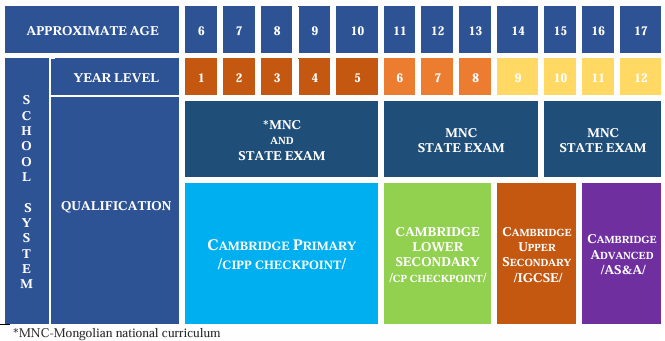
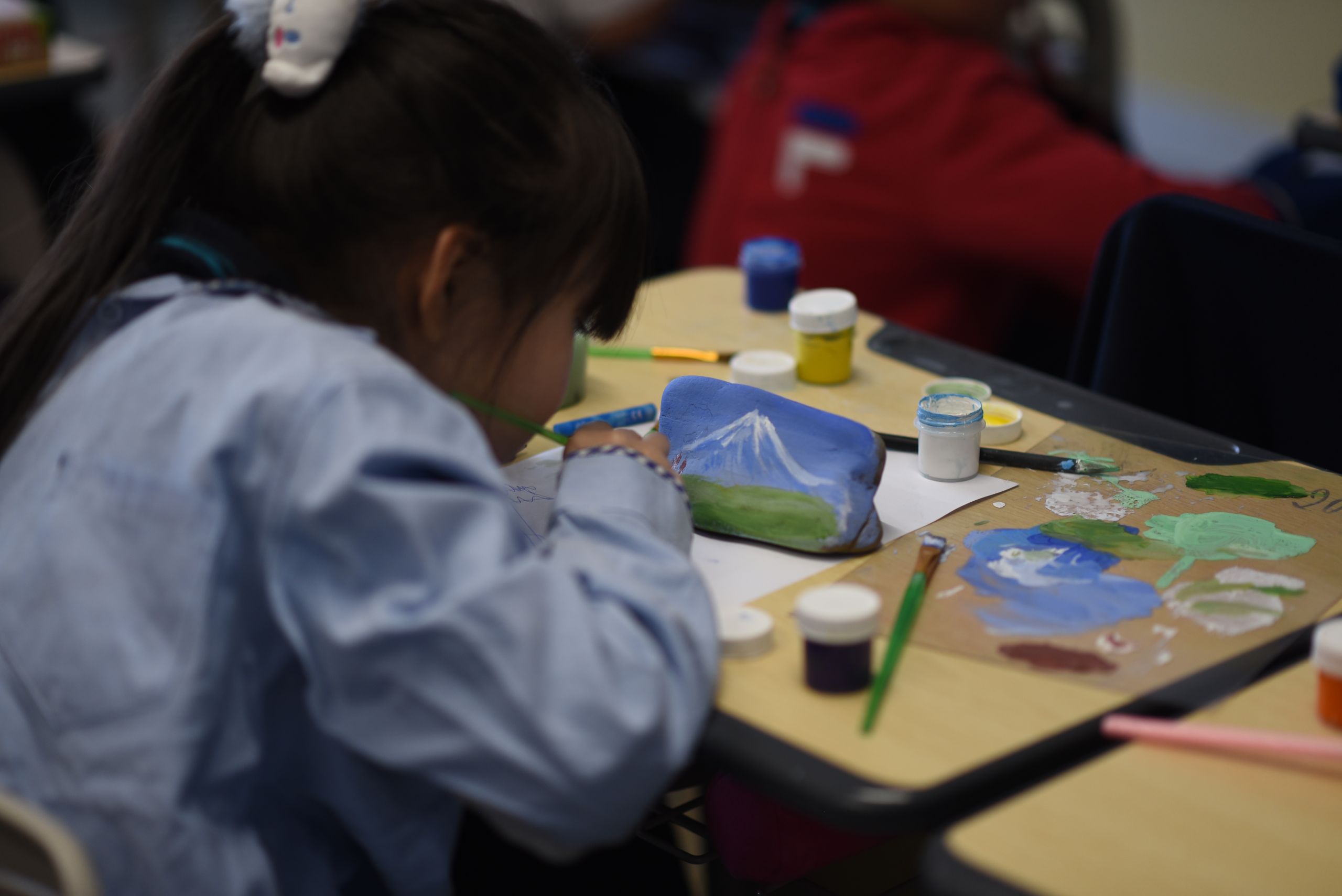
The Mongolian Bilig Oyun International School implements the Cambridge program based on international standards, along with the main national program. The curriculum has the advantage of allowing students to make steady progress in every lesson, practice independent learning, effective teamwork, and experimentation. The program is characterized by a student-centered approach to learning in which the student develops with the help of a teacher to become a lifelong learner with skills such as self-development and self-esteem.
Confident – explaining, analysing and evaluating global issues and communicating arguments
Responsible – researching extensively and selecting suitable material from a globally diverse range of sources, directing their own learning
Reflective – developing a critical awareness of their personal standpoint and how that impacts on their response to different opinions and diverse ways of thinking
Innovative – thinking creatively to propose solutions to issues
Engaged – working collaboratively to develop each individual’s potential in pursuit of a common goal.
